Airlock and Snowflake: implementing agent-oriented architecture
From Concept to Implementation
Agent-oriented architecture separates the tools that do work from the layers that govern and remember it. Airlock exists to make that architecture usable inside Snowflake.
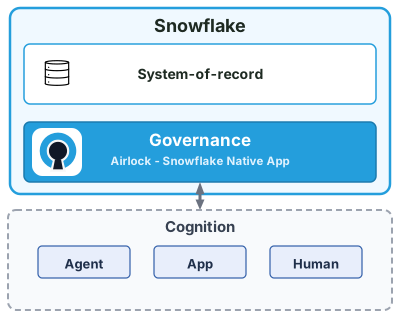
For many teams, this asks Snowflake to play a different role than it traditionally has. Snowflake is no longer only the downstream analytics platform that receives synchronized data after the real work happens somewhere else. It becomes the primary system of record: the place where governed submissions, decisions, evidence, workflow state, and accepted business records live.
Snowflake as the Governed Center
That changes how to think about apps. Apps are not automatically systems of record. We recommend thinking about them in two broad categories: interfaces and internal apps.
Interfaces are apps that touch the real or digital world outside your business. They reach customers, move money, update storefronts, answer messages, publish content, send invoices, collect payments, and make promises the business must keep. They are the limbs and appendages of the business, not additional brains. We are not proposing that teams vibe-code those away or that Snowflake can play these roles. Apps that are interfaces will be durable and survive the "SaaS is dead" apocalypse.
Internal apps, on the other hand, are candidates for replacement and dramatic continuous innovation inside an AI-enabled business. These are the apps that help teams observe, orient, decide, and act: reconcile context, prepare submissions, route approvals, manage evidence, and turn approved work into governed records. They are better candidates for bespoke tools, vibe-coded apps, and AI agents because they do not need to own the ledger, permission model, review process, or audit trail.
Airlock enforces and communicates the rules for data moving into and out of Snowflake. Apps, agents, and humans prepare and propose work through Airlock. Accepted submissions become governed records in Snowflake, and approved records can drive action back through the real-world interfaces the business already uses.
Observe, Orient, Decide, Act
We find it very useful to think of internal apps, and business functions in general, as part of the observe, orient, decide, act loop. The OODA loop comes from John Boyd's military strategy work, especially his Air University Press edition of A Discourse on Winning and Losing.
Observe and act are often the easiest operations to automate when a team has the resources to build, deploy, and manage cloud infrastructure and API calls. In a typical Snowflake implementation, the observe side may look like ETL/ELT, and the act side may look like reverse ETL. For many teams, AI agents can become an option even there.
The orient step is where much of the AI-adoption payoff appears. This is where a business plans, compares scenarios, weighs options, reconciles, and decides what the observations mean. Almost every meeting, presentation, internal document, spreadsheet, and analysis is part of orienting. Orient can be highly automated: AI agents can reconcile systems, propose actions or changes, report bugs and issues, categorize and triage work, track deadlines, and evaluate the impact of external factors such as competitor pricing, new technologies, new capabilities, shifting trends, and the weather.
Decide is where human authority still matters most, usually with an AI copilot alongside it: approve payroll, approve new pricing, approve new product descriptions, approve the drafted email. As a team gains confidence in its AI tools, it may be able to categorize some decisions as routine or low impact and automate parts of the decide step as well.
Act is the automated workflow triggered by approved, finalized work: send the email, update the storefront, submit the payment, or publish the record. As above, this often looks like automation or reverse-ETL-style work. AI agents make that same pattern easier for businesses that do not want or have traditional tech and cloud infrastructure teams.
Who Airlock Is For
Airlock is for almost everyone who wants flexible internal work without turning every spreadsheet, app, workflow, or agent into another system of record.
If you are not experimenting with AI agents, but you are a team using spreadsheets like Excel, Airlock is for you. Excel is the original flexible internal app. Keep using it! Spreadsheets can be chaotic, but they give businesses a way to adapt, plan, compare, and orient themselves around whatever the real business world throws at them. This is why spreadsheets have survived decades of SaaS attempts to replace them. With an agent-oriented architecture pushing data through Airlock into Snowflake, spreadsheets are perfectly suited for the decade ahead.
Non-technical users can use Airlock as a governed way to push Excel files, CSVs, PDFs, images, documents, receipts, and other attachments into Snowflake. In this way, they can push and pull data and files into and out of Snowflake without waiting on a data team, or creating more IT infrastructure. Even better, they get data-quality warnings immediately instead of discovering problems only after a downstream load or test fails, or a user reports a broken dashboard.
If you are adopting AI, Airlock is definitely for you. Define the rules centrally and let capable staff and AI agents get to work. To get started, point your favorite AI at this article, the Airlock docs, the airlock-tools repo for MCP and agent skills, and the sample Airlock specs library, then ask it to evaluate Airlock and propose next steps meaningful to your business and needs.
Airlock is probably not for teams still trying to replace spreadsheets with SaaS apps while avoiding AI, or for teams that want every workflow to be selected centrally, standardized into one vendor interface, and rolled out slowly through a controlled software-adoption process.
Back to Airlock