

How to harness AI:
agent-oriented architecture
Why This Matters
Adopting AI is not simply tool selection or keeping pace with the latest, most capable models. It is also about the architecture, or the harness, that attaches AI to the business.
The agent-oriented architecture described below is meant to be practical, deployable, and useful. You can experiment with it today using Snowflake and Airlock. The implementation is simple, AI-friendly, and impactful. You can start small and grow organically, as value is proven.
The goal is to get more AI agents working on more tasks sooner: to retire legacy infrastructure, code, and apps faster, and to attract and retain AI-fluent, high-agency employees who want to build, automate, experiment, and grow your business far faster than was previously possible.
Choices Ahead
Software on the Internet is commonly delivered as functionality tightly coupled with governance and data storage. A finance tool, sales tool, design tool, or marketing tool gives users a useful operating surface, but it also brings its own permissions model, workflow assumptions, data model, and system of record. This works well enough inside each vertical, but a business that adopts many such tools becomes a patchwork of applications and competing records.
The usual remedy is a constant effort of data movement and synchronization across systems. To provide centralized visibility and cross-system analytics, businesses implement downstream systems such as Snowflake. But success here requires even more investment in data movement, synchronization, IT infrastructure, and a growing security perimeter. Each new application adds another interface, another permission boundary, another integration, and another place where business state may diverge.
AI agents and user-built applications, including bespoke or vibe-coded apps, stress this status-quo business architecture even further. The way forward can look like a choice between two suboptimal paths:
- Path One is to embrace AI everywhere and let the existing architecture absorb the surge. That can mean an exponential increase in the code, apps, agents, and workflows used by the business. The risk is internal: security exposure, compliance gaps, more data pipelines, complexity, and further fragmentation of truth.
- Path Two is to control and sanction AI usage. A business can disallow vibe-coded apps, user-built tools, and AI agents from operating inside real business workflows, permitting AI only in selected, controlled, approved ways while maintaining a documented and compliant array of business apps. The risk is external: a faster-moving competitor may transform the market more quickly than this controlled approach can adapt to.
We argue for and present a third path: an agent-oriented architecture. Specifically, a governance layer around a centralized system of record can give an organization the ability to deploy real AI tools and agents, move real workloads to them, and build the confidence to let AI-fluent, high-agency employees build, vibe-code, and push forward on the front lines of the business.
Agent-Oriented Architecture
An agent-oriented architecture separates the tools that do work from the layers that govern and remember it. Apps, agents, scripts, and spreadsheets can be lightweight, bespoke, and temporary. What stays durable are the rules and the records.
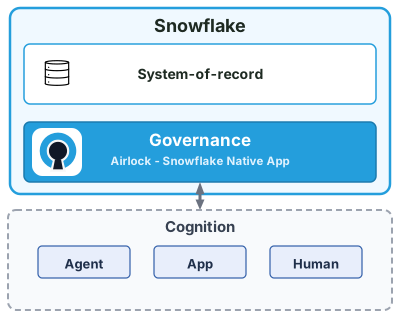
- System-of-record layer: the central system of record for official records, shared context, and historical outputs.
- Governance layer: the rules that define valid submissions, permissions, and workflow policy.
- Cognition layer: apps, AI agents, and humans interpret context, make judgments, and produce work.
This Is Not New
This pattern is how software engineers work with GitHub, how the IRS collects tax filings, and how merchants protected their ledgers before computers or telephones existed.
Software Engineers
Software engineers follow this discipline every day with tools like Git and GitHub. A developer can move quickly in a local branch, whether the code is hand-written, AI-assisted, vibe-coded, or copied from the internet. That branch can be experimental, temporary, and wrong for most of its life. GitHub provides the governance: permissions, workflows, reviews, approvals, history, and access to the version of the code that matters, the system of record. Branches are for drafts. Merges are for accepted work.
Software engineers were quick to adopt AI, not only because they were technical and LLMs were great at coding, but also because their development process already had an agent-oriented architecture, even if they did not call it that. Flexibility and experimentation were allowed at the edge, while tight controls and approvals protected the official version at the center.
The IRS
The IRS (Internal Revenue Service, the tax authority of the U.S.A.) does not care whether a tax filing was prepared in TurboTax, Excel, QuickBooks, paper forms, or a custom app. It cares that the final submission follows the required structure, includes the required information, and was submitted to the central authority on time. Tax tools help the taxpayer think, calculate, gather evidence, evaluate options, and prepare the work. But they are ephemeral. The filing or submission is what becomes the record.
Merchants
In a Renaissance trading house, a clerk could calculate, draft, reconcile, and annotate at a desk, but the books that mattered stayed in the counting house, under lock, and under the authority of the firm or the owner. Working papers could be messy. The official ledger could not. This is why we see painting after painting of wealthy merchants with their ledgers, actively writing in them. Success in business has always required expansive, adaptive, and chaotic work in the real world, but with strong governance around a central ledger.



These examples all point to a durable organizational problem. Principal-agent theory described the trust problem in 1973: a business wants to grow, but growth means delegating work to people it cannot fully see or control. In a slower and more predictable world, the answer often looked like management by process manual, rule book, and approved application. The ideal agent was a trustworthy rule follower. That is not enough now. Growth increasingly depends on adaptation, creation, experimentation, and judgment at the edge. An agent-oriented architecture gives high-agency people and their tools room to respond to real conditions while preserving a governed place where accepted work becomes official. Business has always had agents: employees, clerks, managers, captains, consultants, and contractors. Now the names are expanding to bots, AI agents, copilots, "clankers", and whatever nickname a team gives its next useful assistant.
What Changes for Businesses
Work like the IRS.
Your job is not to select the right app for everyone to use. Your job is to define the form, the specification, and the rules of submission. What does acceptable work look like? What steps occur after submission to evaluate that work? How do you signal acceptance or rejection? How do you provide feedback or remediation instructions?
You do not need a budget app. You need clear rules so ten different employees can vibe-code their own budget app, use spreadsheets, or talk to AI agents to figure out their budgets in whatever chaotic, bespoke way works for them, then submit the budget request to you, according to spec.
The behavior change is simple: stop looking to apps for governance or to be the system of record. Apps are now ephemeral, like spreadsheets and sticky notes. Immensely valuable for doing work, but not the place where work is finalized or stored.
You are now the IRS. You publish specifications. You accept submissions.
The Governance Layer
Once apps and agents become drafting tools, everything turns on the governance layer: the submission boundary. The question is no longer, "Do we trust this app?" The question is, "Does this submission satisfy the specification?"
The boundary is where the business says yes or no. It is where the business enforces and communicates the rules.
Without that boundary, AI adoption becomes either chaos or lockdown. With it, you can say yes to more tools, more agents, more experiments, and more useful work at the edge.
The Flywheel
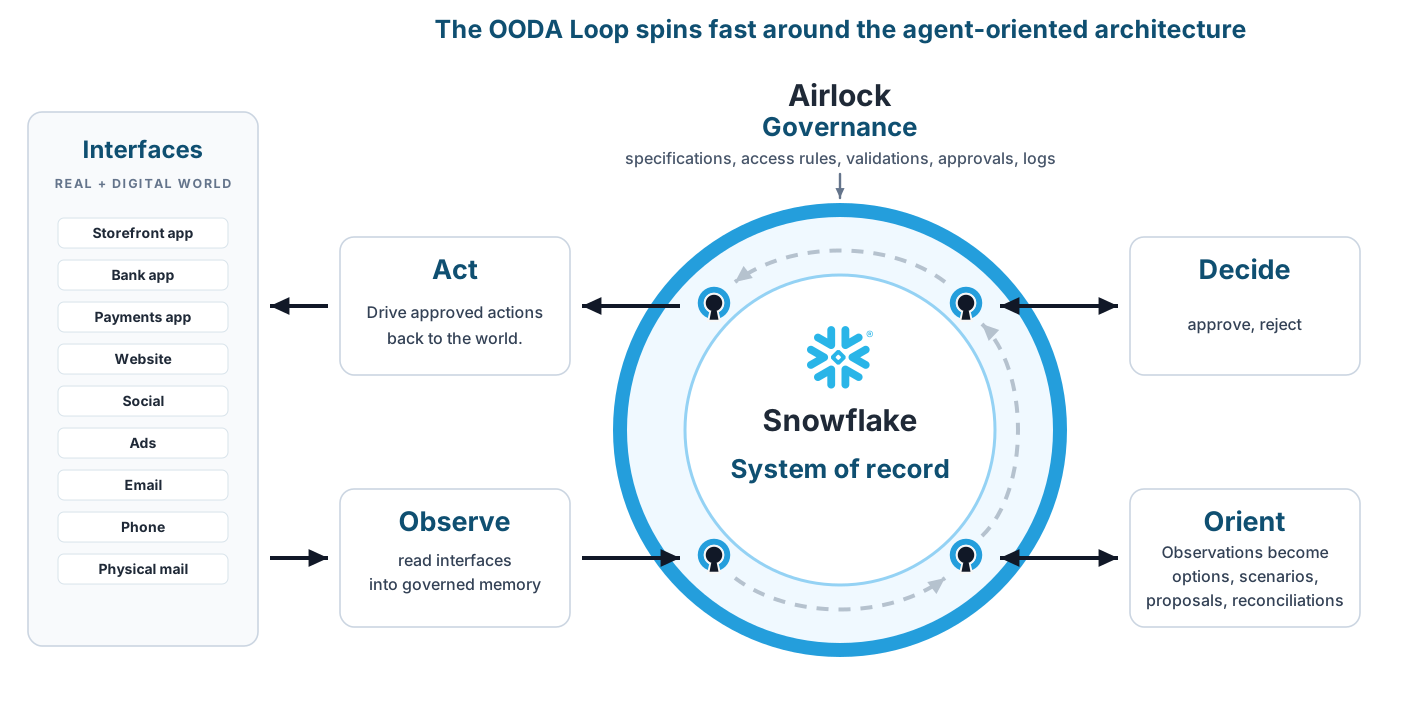
Once the submission boundary exists, you can begin to build an AI-enabled business flywheel of observe, orient, decide, and act: the OODA loop for accelerating business growth and automating the mundane operations that slow you down or slip through the cracks.
Airlock Is Available Today
This is why Airlock exists. Airlock gives Snowflake a governed submission boundary to define, communicate, and enforce specifications.
Teams or individual employees can experiment with AI agents like OpenClaw, move real data submissions through a governed surface, and grow organically as those submissions, and the AI-enabled, ever-changing, vibe-coded, bespoke processes that produced them, prove value.
Learn more about how Snowflake and Airlock implement this pattern.
Back to Airlock